

Why Encourage Flexibility Training to Your Members


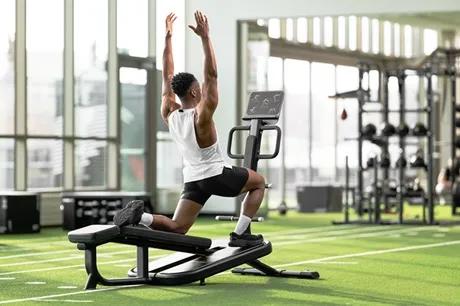
Many of your members consider resistance training the foundation of their weekly routines, with flexibility training taking a back seat. While some lifters avoid stretching due to misconceptions about strength interference, research suggests that flexibility and strength are not opposing forces. Instead, these can be complementary parts of a well-balanced routine.
Tension Drives Adaptations
Both strength and flexibility training induce beneficial adaptations by increasing mechanical tension. Such forces are detected by sensors in the muscles, converting them into biochemical signals. And these signals activate anabolic responses in the muscle, increasing protein synthesis and muscle growth.
Harness Both for Better Results
Some sensors in the muscle respond more to active, contractile forces that are common to strength training. Other sensors respond more to passive stretch-based tension. It’s important to know that many forms of both stretching and strength training involve active and passive tension. For more specifics on stretching types and scheduling considerations, explore Flexibility Training Guide at the bottom of this article.
The anabolic response to both active and passive tension helps to explain how strength training can improve flexibility¹ and how flexibility training can enhance strength.2,3,4 The overlapping benefits suggest that strength and flexibility training offer complementary, rather than competing stimuli for muscle improvements.
The “Dose” for Gains
Flexibility training on its own can improve muscle strength and size in ways that mimic strength training. One study5 that underscores this idea compared muscle strength and thickness following either an 8-week routine of intense pec stretching (15-minute static stretches, 10/10 pain tolerance, 4 days a week) or strength training (on a pec fly machine for 5 sets of 10-12 reps, three times a week).
Post-tests revealed that both routines offered comparable strength and size gains, with no difference between the groups for improvements in muscle strength (+10%) and pec muscle thickness (+6%). While resistance training offers a more efficient route based on invested time, effort and outcome, the findings clarify that flexibility training at a sufficient intensity can enhance muscle strength and size.
Balancing Strength & Flexibility Training
As you guide members toward well-rounded routines, strategic scheduling can reduce the potential for flexibility training to interfere with strength-based performance. This is primarily relevant for the warm-up, because prolonged static stretching just before lifting may temporarily reduce maximal strength.6
Reviews on this topic6 emphasize that simple adjustments can eliminate the issue. For instance, holding static stretches for 60 seconds or more mildly reduces force production, yet shorter holds of 45 seconds or less can be used in warm-up routines without impacting maximal strength. Also, other forms of stretching, such as dynamic stretching during the warm-up, do not pose an issue for members who want to capitalize on every strength training session.
Experienced Lifters Also Benefit
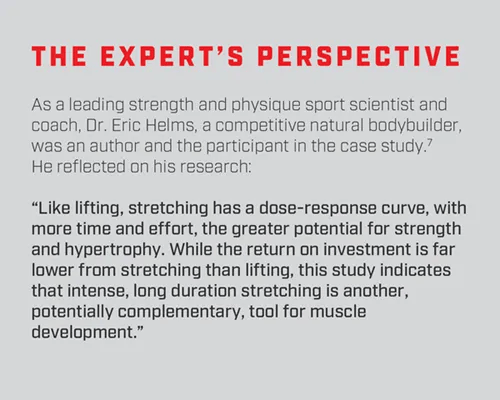
Research on combining strength and flexibility training is limited, especially in individuals with extensive strength training backgrounds. A recent case study7 helps fill this gap by examining the effects of prolonged stretching on an individual with nearly two decades of bodybuilding experience, offering new insights into how flexibility training may impact well-trained athletes.
In the study,7 the individual maintained regular strength training across all major muscle groups, training calves five times per week. Then for 12 weeks, he added one-hour static calf stretches six days per week on top of his habitual calf training. Although adaptations in highly trained individuals are often minimal, this intensive stretching protocol led to a 26% increase in flexibility, an 11% improvement in strength and up to a 23% increase in muscle thickness in certain areas of the calf. These results, which were greater than his typical rate of progress with lifting alone, suggest that even experienced lifters may enhance muscle strength, size and range of motion through dedicated flexibility training.
Importantly, he wore a calf stretching boot that maintained him at an 8/10 stretch tolerance for an hour, nearly every day. Substantial time investment and intensity are needed to get comparable gains; however, the outcomes reinforce that dedicated flexibility training can contribute to significant muscle development, even in highly trained individuals who already lift through a full range of motion.
Advantages for Your Members
While size and strength gains are not guaranteed with stretching, they are possible when using intensive flexibility training protocols. Set realistic expectations for members but emphasize that both flexibility and strength training contribute to a well-rounded program. Unfortunately, the flexibility research does not support a clear injury-reduction advantage, yet flexibility training can enhance their overall facility experience in several keyways:
- Welcoming for Beginners and Returning Members: Flexibility training provides a low-barrier entry point for those with lower baseline strength or fitness. It also helps re-engage returning members who may feel intimidated by higher-intensity workouts.
- A Tool for Active Recovery: Members recovering from muscle soreness, injury, or poor sleep can still engage at your facility through flexibility training. This reinforces your gym as a space for all workout intensities while helping members avoid overtraining.
- Improves Facility Flow: Offering structured flexibility options encourages members to use underutilized spaces, reducing crowding in high demand training areas and allowing for more efficient workouts.
- Builds Community Across Strength & Fitness Levels: Group flexibility sessions provide a way for members of different strength and fitness backgrounds to train together, creating new connections and a more inclusive atmosphere.
Takeaways for Fitness Professionals
Whether through dedicated stretching sessions, active recovery options or structured cool-downs, encouraging flexibility training can enhance member results and their experience in your facility. Remind members that dedicated flexibility sessions of sufficient intensity and/or duration completed several times a week may improve muscle strength,1,2,4,5,7 size,2,5,6,7 and supports overall exercise performance.3

Karlie Intlekofer, PhD, CNC, CPT
References
- Roberto et al. The influence of strength, flexibility and simultaneous training on flexibility and strength gains. Strength and Conditioning Research 2011; 25(5): 1333-8.
- Warneke et al. Influence of long-lasting static stretching on maximum strength, muscle thickness and flexibility. Frontiers in Physiology 2022; 13: 878955.
- Kokkonen et al. Chronic static stretching improves exercise performance. Med Sci Sports Exerc 2007; 39: 1825-31.
- Nelson et al. A 10-week stretching program increases strength in the contralateral muscle. J Strength Cond Res 2012; 26: 832-36.
- Wohlann et al. Influence of 8-weeks of supervised static stretching or resistance training of pectoral major muscles on maximal strength, muscle thickness and range of motion. European Journal of Applied Physiology 2024; 124(6): 1885-93.
- Warneke & Lohmann. Revisiting the stretch-induced force deficit: A systematic review with multilevel meta-analysis of acute effects. Journal of Sport and Health Science 2024; 13(6): 805-19.
- Homer et al. The effect of a combined long-duration static stretching and resistance training regimen on a competitive bodybuilder: A case study. Physiol Rep 2025; 13(2): e70156.

